
“`html
Microsoft’s vulnerability environment has just conveyed a confusing message that every security team must comprehend. As per the recently published Microsoft Vulnerabilities Report 2026 — the 13th annual version released by BeyondTrust — the overall number of reported Microsoft vulnerabilities has actually decreased by 6% from the previous year, going from 1,360 in 2024 to 1,273 in 2025. At first glance, this appears to be positive news.
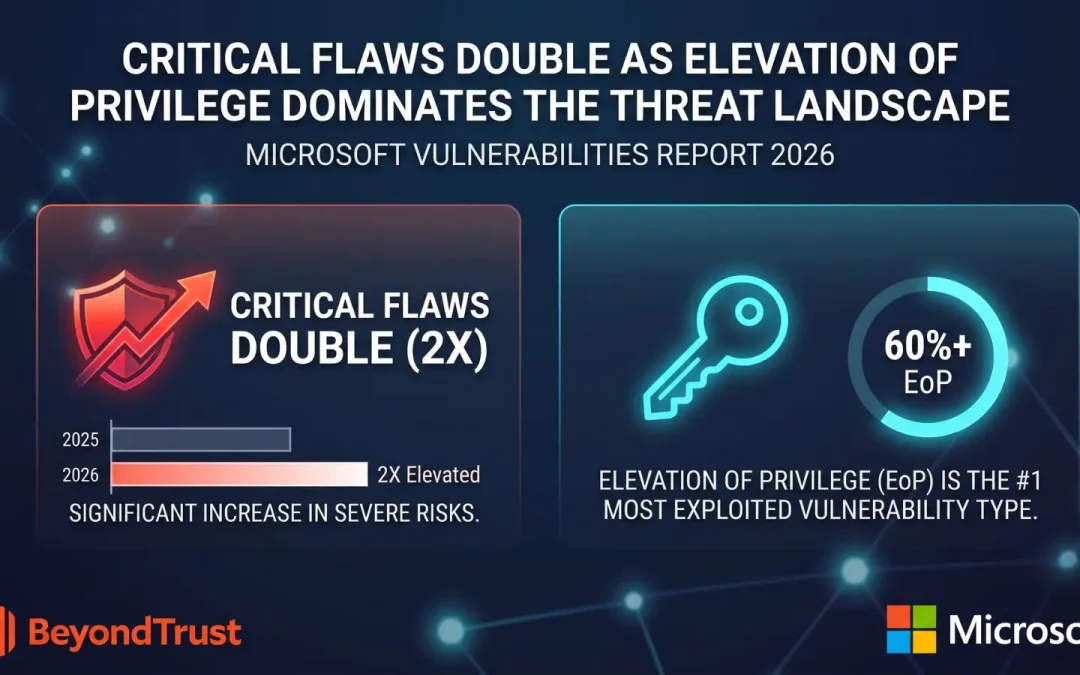
However, it is not. Hidden within that slight reduction is a figure that should alarm every CISO, system administrator, and identity architect overseeing a Microsoft environment: critical vulnerabilities have more than doubled, escalating from 78 to 157 in a single year. While there are fewer bugs, a significantly greater number of them are capable of full system compromise.
This is the core contradiction presented in the Microsoft Vulnerabilities Report 2026, and it is precisely why the information from this year’s report requires a more thorough technical examination than the headline figures imply.
This article dissects the report’s essential CVE statistics by category and product, clarifies the technical dynamics behind the Elevation of Privilege and Remote Code Execution trends that are fueling risk, and examines how BeyondTrust’s identity security framework is designed specifically to mitigate the exposure window these vulnerabilities generate.
For the full dataset, five-year historical analysis, and expert insights from Microsoft MVPs alongside BeyondTrust’s own research group, download the complete 2026 Microsoft Vulnerabilities Report from BeyondTrust.
Why the Microsoft Vulnerabilities Report 2026 is Significant
For thirteen consecutive years, BeyondTrust has collected and evaluated every security bulletin released by Microsoft, categorizing CVEs by product, severity, and type of vulnerability (Elevation of Privilege, Remote Code Execution, Information Disclosure, Denial of Service, Spoofing, Tampering, and Security Feature Bypass).

This longitudinal dataset positions the Microsoft Vulnerabilities Report 2026 as one of the few references that allows defenders to observe structural changes in Microsoft’s attack surface rather than just a single anomalous year.
The prominent trend over the past decade had been encouraging: the portion of critical vulnerabilities relative to the total decreased from 44% in 2013 to merely 5.74% in 2024, indicating Microsoft’s investments in secure-by-design practices, Patch Tuesday schedules, and exploit prevention efforts.
The 2026 report disrupts that pattern. The share of critical severity in total vulnerabilities surged back above 12% in 2025 — a reversal that Microsoft MVP and Senior Technical Fellow at Adminize, Sami Laiho, along with other contributing experts, identify as a real change in risk distribution, not mere statistical variance.

Figure 1: Total Microsoft CVE volume has maintained a relatively narrow range since 2022, but the volume alone does not convey the complete risk narrative.
Critical Vulnerabilities Have Doubled: The Figures Behind the Headline
The most crucial figure in the Microsoft Vulnerabilities Report 2026 is the count of critical vulnerabilities: 157 in 2025, an increase from 78 in 2024. This is not a trivial rise — it reflects a 101% surge in the category of flaws most likely to facilitate remote, unauthenticated, or low-complexity full compromise.
One methodological detail worth highlighting: the figure of 157 is based on Microsoft’s Security Update Severity Rating System, which assesses real-world exploitability.
According to the National Vulnerability Database’s CVSS v4 scoring, only 42 Microsoft vulnerabilities surpassed the critical threshold in 2025 (up from 39 in 2024).
The report clearly states that organizations focusing on patches based solely on CVSS may significantly underestimate their exposure — Microsoft’s own severity rating serves as the more relevant indicator for defenders.
Two Products Were Primarily Responsible for That Surge:
Microsoft Azure and Dynamics 365 experienced a ninefold increase in critical vulnerabilities, escalating from just 4 in 2024 to 37 in 2025. Azure is now the foundational layer hosting Copilot integrations, AI agents, and machine-identity workloads that authenticate and operate with elevated permissions.
A nearly tenfold rise in critical flaws in that exact layer — coupled with the growth of autonomous non-human identities — represents a compounding risk rather than a standalone figure, a concern independently identified by security researcher Jane Frankland MBE in the complete report.
The most notable vulnerability of the year was CVE-2025-55241, a critical flaw in Entra ID token forgery.
“““html
(CVSS 10.0) that could have permitted an assailant to mimic any identity — including a Global Administrator — across any tenant, without any user involvement and without logs created in the target tenant.
Microsoft remedied it in July 2025, with no verified exploitation in the wild, but it exemplifies how a solitary cloud-identity vulnerability can dismantle trust boundaries at machine speed.
The vulnerabilities in Microsoft Office saw an increase of more than threefold year-over-year, escalating from 47 in 2024 to 157 in 2025, with severe Office vulnerabilities soaring from 3 to 31 — approximately a 10x rise.
Considering that Office continues to be one of the most prevalent initial-access channels — through harmful macros, OLE objects, and document-based exploit chains — this surge significantly alters the phishing and document-based attack equations for defenders.
Prominent instances include CVE-2025-62557 and CVE-2025-62554, a combination of memory-corruption and type-confusion enabling remote code execution via the file preview pane, requiring no user interaction.
Not all products trended negatively. Microsoft Edge was the notable success story, dropping to only 50 vulnerabilities in 2025 — none of which were critical — an 83% decrease year-over-year that underscores the advancement of Chromium-based hardening efforts.
That’s the type of secure-by-design advancement the industry aims to see replicated throughout the Microsoft ecosystem.

Figure 2: Critical vulnerabilities nearly doubled overall, with Azure/Dynamics 365 experiencing the most significant year-over-year rise.
→ Access the complete report for the full technical appendix and patch-prioritization information →
Elevation of Privilege Continues to Dominate the Vulnerability Landscape
If there’s a single category that characterizes the contemporary Microsoft vulnerability landscape, it’s Elevation of Privilege (EoP). In 2025, EoP vulnerabilities comprised 509 CVEs — 40% of every vulnerability Microsoft disclosed across its complete product suite.
This positions it as the largest vulnerability category for yet another consecutive year, maintaining a multi-year trend the report has monitored since its initial editions.
From a technical standpoint, EoP vulnerabilities are more significant than raw counts indicate due to how modern attack chains are structured. Initial access seldom requires a sophisticated zero-day; attackers increasingly depend on phishing, credential theft, token replay, or misconfigured service accounts to establish a low-privilege foothold.
From there, an EoP vulnerability — in the Windows kernel, in a driver, in an Active Directory service, or in an Azure control-plane component — is what transforms that restricted foothold into domain admin, root, or complete cloud-tenant control.
Remote Code Execution (RCE) vulnerabilities, the second-largest category with 373 disclosures in 2025, frequently act as the second half of that same chain: gain code execution, then elevate.
Information Disclosure was the sole category to trend negatively, surging 73% from 101 to 175 CVEs — the silent precursor that aids attackers in mapping an environment prior to the next stage.
Windows and Windows Server — the two platforms where identity, authentication, and privilege boundaries are genuinely enforced — continue to be the largest sources of raw CVE volume. In 2025, Windows accounted for 612 disclosed vulnerabilities (36 critical), while Windows Server had 780 vulnerabilities (50 critical).
Together, these two platforms represent the operating system layer where privileged access management controls must do the most substantial work. (Note: some CVEs impact both Windows and Windows Server and are counted in each product tally, so the two totals should not be combined as a distinct sum.)

Figure 3: Elevation of Privilege accounts for 40% of all 2025 Microsoft CVEs; Windows Server and Windows remain the principal sources of vulnerability volume.
As BeyondTrust CTO Marc Maiffret highlights in the report, CVE counts alone provide an incomplete picture: identity misconfigurations, over-privileged machine accounts, and AI agents with unrestricted access do not receive CVE numbers, yet they carry the same ramifications as a critical vulnerability once exploited.
That’s the analytical perspective this report guides security leaders toward — contemplating Paths to Privilege™, not merely patch counts.
The Technical Rationale for Least Privilege and Zero Trust
Every edition of the Microsoft Vulnerabilities Report reinforces the same architectural insight, and 2026 is no different: vulnerabilities are inevitable, but their impact radius is not. As Sami Laiho articulates in this year’s report, the real risk in modern environments isn’t the existence of vulnerabilities — it’s the presence of superfluous privilege.
Organizations that prioritize least privilege as a foundational design principle may not eliminate CVEs, but they significantly reduce what any single…
“`
exploit can indeed achieve.
That concept converts into tangible technical measures:
- Revoking local administrator privileges and persistent elevated access on endpoints so that an EoP exploit has no significant escalation path.
- Implementing just-in-time, just-sufficient access for both human administrators and service accounts across Windows, Windows Server, and Azure/Entra ID platforms.
- Ongoing discovery and regulation of non-human identities — service principals, API keys, and AI agent credentials — that increasingly function with ongoing, unmonitored privileges in cloud settings.
- Dividing and observing remote access routes, as compromised remote sessions continue to be one of the most frequent methods attackers use to exploit systems with unpatched Elevation of Privilege or Remote Code Execution vulnerabilities initially.
David (DJ) Morimanno, Field CTO at Xalient, frames it in Zero Trust terminology in the report: contemporary defense is not about presuming trust and reacting after the fact; it’s about continuously verifying trust and limiting privileges for every identity, whether human or non-human.
That’s exactly the operational model the 2025 data is steering organizations towards.
How BeyondTrust Assists in Bridging the Identity Privilege Divide
This is where the report’s conclusions directly relate to BeyondTrust’s own platform strategy. Trusted by over 20,000 clients, including 75 of the Fortune 100, and acknowledged as a Leader in the 2025 Gartner® Magic Quadrant™ for Privileged Access Management, the 2025 Forrester Wave™ for Privileged Identity Management, and the 2025 KuppingerCole Leadership Compass for ITDR, BeyondTrust regards vulnerability management and identity security as a singular interconnected discipline instead of two distinct ones.
The BeyondTrust Pathfinder Platform consolidates privilege-centric identity security functionalities — Privileged Access Management (PAM), Identity Threat Detection and Response (ITDR), Cloud Infrastructure Entitlement Management (CIEM), and Secrets Management — into a unified console designed around the precise attack chain articulated in the 2026 report. Here are some specific ways BeyondTrust addresses the distinct risks highlighted by this year’s data:
- Endpoint Privilege Management revokes standing local admin rights from Windows and Windows Server endpoints — the two platforms accountable for the majority of 2025 CVE volume. Revoking local admin permissions alone has historically mitigated approximately 75% of Microsoft’s critical vulnerabilities, achieving this before any patches are applied — a compensatory control that directly reduces the effect of the 509 Elevation of Privilege vulnerabilities revealed this year.
- Password Safe and Total PASM administer, rotate, and monitor privileged credentials across on-premises and Azure environments, directly countering the risks posed by the 9x increase in critical Azure and Dynamics 365 vulnerabilities and the unmanaged machine identities functioning within that infrastructure layer.
- Identity Security Insights continuously discovers privileged accounts, outdated entitlements, and perilous identity connections across hybrid Microsoft and multi-cloud environments — mapping True Privilege™ to uncover the real attack landscape instead of the organizational chart, and providing security teams insight into the “invisible” privilege risks that often do not receive a CVE designation yet pose equivalent threats.
- Privileged Remote Access secures and audits all remote sessions into Windows Server and critical infrastructure, shutting off one of the most common paths attackers employ to access systems that remain vulnerable to this year’s Remote Code Execution and Elevation of Privilege disclosures.
Together, these features implement the least-privilege and Zero Trust recommendations that the report’s contributing experts — ranging from Microsoft MVPs to BeyondTrust’s Phantom Labs™ research team — assert are now essential rather than optional. For a complete technical breakdown of every product category, the full five-year vulnerability trendlines, and detailed guidance from Microsoft security researchers and BeyondTrust’s own threat intelligence team, access the 2026 Microsoft Vulnerabilities Report here.
Key Insights from the Microsoft Vulnerabilities Report 2026
- Total Microsoft vulnerabilities declined by 6% to 1,273 in 2025, but critical vulnerabilities multiplied to 157, reversing more than a decade of consistent improvement.
- Elevation of Privilege remains the largest single category of vulnerabilities at 40% of all CVEs, confirming that identity and privilege — rather than sheer patch counts — are the genuine attack surfaces that need defending.
- Critical vulnerabilities in Azure and Dynamics 365 surged 9x, posing a direct concern for any organization utilizing AI agents or Copilot workloads within that framework.
- Windows (612 CVEs) and Windows Server (780 CVEs) continue to be the predominant sources of vulnerability occurrences, highlighting why controls for endpoint and server privileges are even more crucial than the speed of patching.
- Microsoft Edge’s 83% yearly decrease illustrates that investments in secure-by-design approaches significantly lower vulnerability counts over time.
Concluding Thoughts
The Microsoft Vulnerabilities Report 2026 makes one aspect decidedly clear: patch management alone is no longer an adequate defense against a Microsoft vulnerability landscape where critical issues are consolidating in cloud infrastructure and identity boundaries.
Organizations that combine disciplined patching with least-privilege enforcement, ongoing identity governance, and Zero Trust access controls are the ones most effectively equipped to endure a year where fewer vulnerabilities somehow translate into greater risk.
To view the complete dataset — inclusive of five-year historical trends, category-wise CVE breakdowns, and expert commentary from Microsoft MVPs Sami Laiho and Paula Januszkiewicz, security researcher Katie Moussouris, and BeyondTrust’s security leadership — download the 2026 Microsoft Vulnerabilities Report now and explore how BeyondTrust’s Pathfinder Platform can assist your organization in closing the privilege gap before attackers exploit it.
→ Download the 2026 Microsoft Vulnerabilities Report (13th Edition) →
→ Have inquiries about your identity security stance? Consult with a BeyondTrust expert →
