
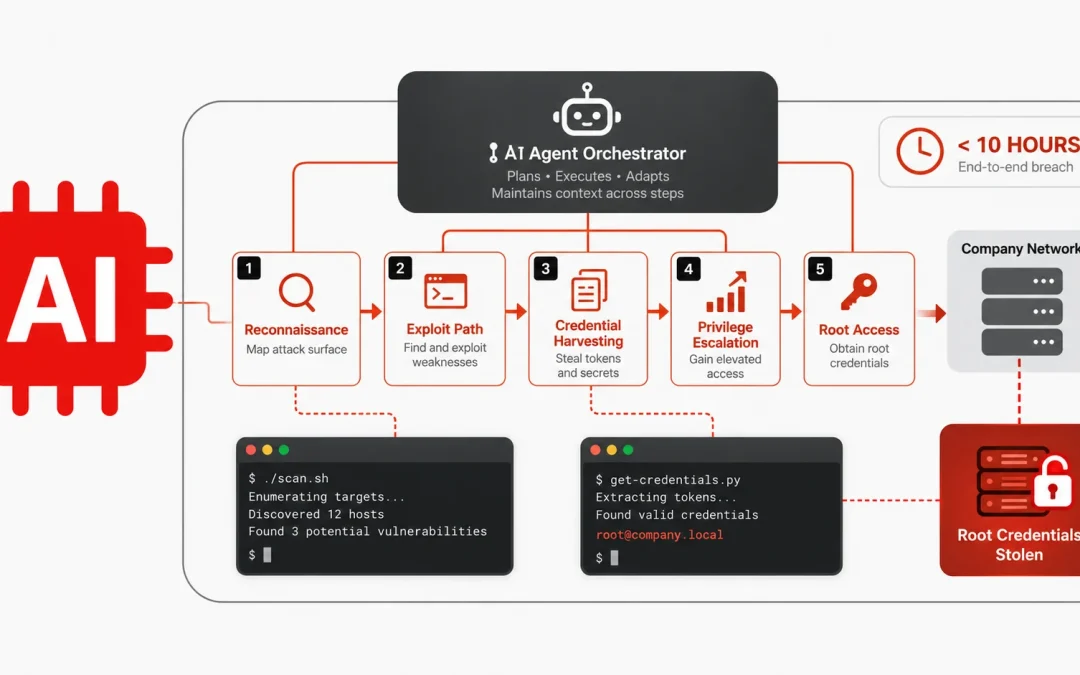
A human attacker armed with frontier artificial intelligence models breached an enterprise network and seized root credentials in under 10 hours, a timeline that would normally take human red teams roughly two weeks to complete, according to a new incident response report from Palo Alto Networks’ Unit 42.
The threat actor told Unit 42 investigators during ransom negotiations that they relied on frontier AI models paired with attack-specific agentic AI frameworks to automate the intrusion.
Rather than manually executing each stage of the attack, the operator directed AI agents to monitor, evaluate, act, and re-plan in real time, compressing more than 50 distinct MITRE ATT&CK techniques into a single automated loop.
Unit 42 noted that the attack did not rely on a zero-day exploit or unusually sophisticated tradecraft, but instead achieved its speed and scale purely through AI-assisted operational efficiency.
AI Agents Breach Company Network
Once the agents gained initial access by breaching a publicly accessible web service, they tunneled into the network and deployed an automated reconnaissance agent to map internal microservices.
From there, sub-agents combed through enterprise code repositories, harvesting hard-coded tokens and service passwords. The attacker then used those exposed tokens to infiltrate the organization’s secrets management system, extracting master administrative credentials that granted root-level access across the environment.
The agents did not stop at credential theft. They hijacked the company’s CI/CD pipeline through custom workflows to exfiltrate cloud access keys and attempted to plant backdoors inside Terraform infrastructure-as-code configurations, an effort that was ultimately blocked by branch-protection controls.
Using the stolen cloud keys, the attacker also seized control of the victim’s AI infrastructure, repurposing the company’s own compute resources to support future stages of the attack.
Unit 42 identified several telltale signs of AI-driven operations, including parallel calls to multiple large language models, structured Markdown files used to pass information between agent sessions, and custom scripts bearing UI elements consistent with AI-generated code.
In an unusual twist, the attacker also directed the agents to compile an 80-page technical audit of the victim’s security weaknesses, effectively automating a full penetration-testing report as leverage.
Researchers warned that adversaries are increasingly likely to fold autonomous AI agents into their toolkits, since the technology helps establish redundant persistence across SSH keys, cloud identities, and CI/CD pipelines simultaneously.
To counter machine-speed attacks, Unit 42 recommends that organizations deploy synchronized containment playbooks that can instantly revoke credentials and freeze pipelines, treat AI models and API keys as core infrastructure requiring strict governance, and enforce mandatory multi-party code review on infrastructure-as-code repositories to block automated backdoor injection.