
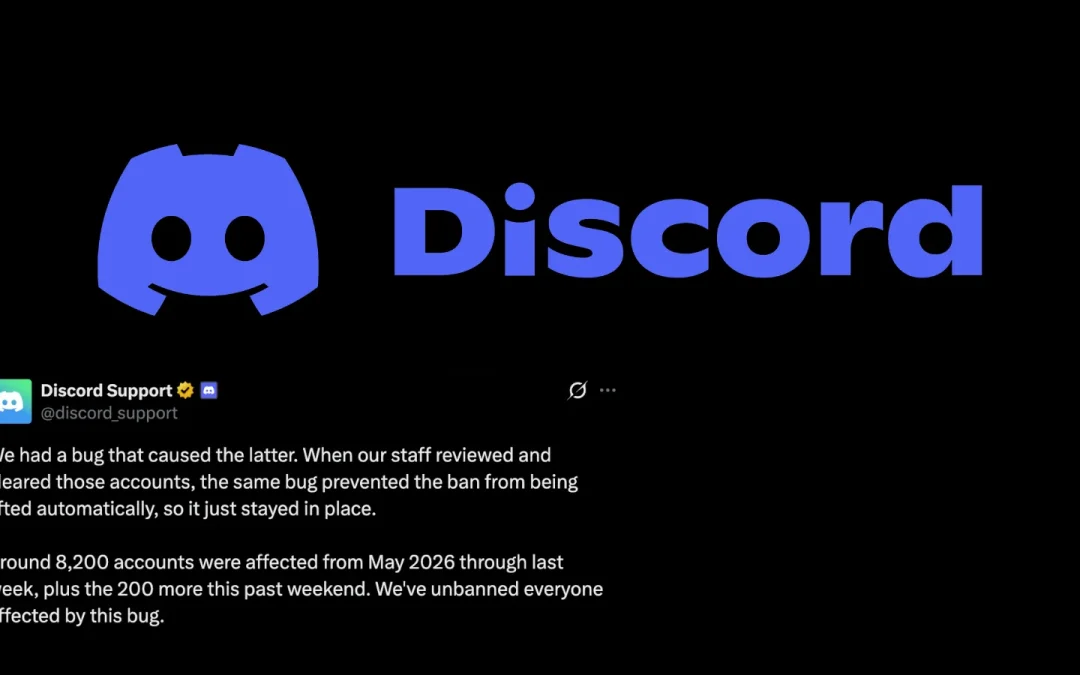
Discord has confirmed that a bug in its automated security systems led to the wrongful suspension of more than 8,000 user accounts between May 2026 and early July 2026. The company disclosed the issue via its official support account on X, clarifying both the root cause and the scope of impact.
According to Discord Support, the incident stemmed from a two-part failure in its moderation pipeline. The first issue caused the platform’s automated detection systems to incorrectly flag and ban legitimate accounts, mistaking normal user behavior for policy violations.
Discord did not specify which detection mechanism triggered the false positives, though such systems typically rely on behavioral heuristics, spam-pattern recognition, or automated abuse signals.
The second, more damaging issue compounded the problem. When Discord’s Trust & Safety staff manually reviewed flagged accounts and cleared them as legitimate, a separate bug prevented the unban action from actually processing.
As a result, accounts that staff had already approved for reinstatement remained locked out, with the erroneous ban persisting despite internal clearance.
“We had a bug that caused the latter,” Discord Support stated, referring to the failure in the unban process. “When our staff reviewed and cleared those accounts, the same bug prevented the ban from being lifted automatically, so it just stayed in place.”
Discord estimates that roughly 8,200 accounts were affected by the bug between May 2026 and the final week of June 2026. An additional 200 accounts were affected by the issue over the following weekend, bringing the total to more than 8,400 users impacted.
The extended timeline spanning nearly two months suggests the bug went undetected or unresolved for a significant period, raising questions about how Discord’s internal monitoring flagged (or failed to flag) the anomaly sooner.
For affected users, this meant potentially weeks of lost access to servers, direct messages, and community participation despite doing nothing wrong.
Discord says it has now unbanned every account affected by the bug. The company’s statement did not detail the specific technical fix applied to the moderation and appeals systems, nor did it specify whether affected users will receive any communication, compensation, or explanation beyond the public post.
Automated moderation at platform scale is inherently prone to false positives, but the real failure here was systemic: even when human review correctly identified the mistake, a separate software bug blocked the fix from taking effect.
This highlights a growing risk across large platforms as security automation expands to handle scale: redundant faults in the remediation pipeline can leave legitimate users locked out far longer than the initial detection error alone would cause.
For a platform with hundreds of millions of active users, an impact of 8,000 accounts is statistically small, but the incident underscores the importance of a resilient appeals infrastructure that doesn’t fail silently, even after manual correction.