
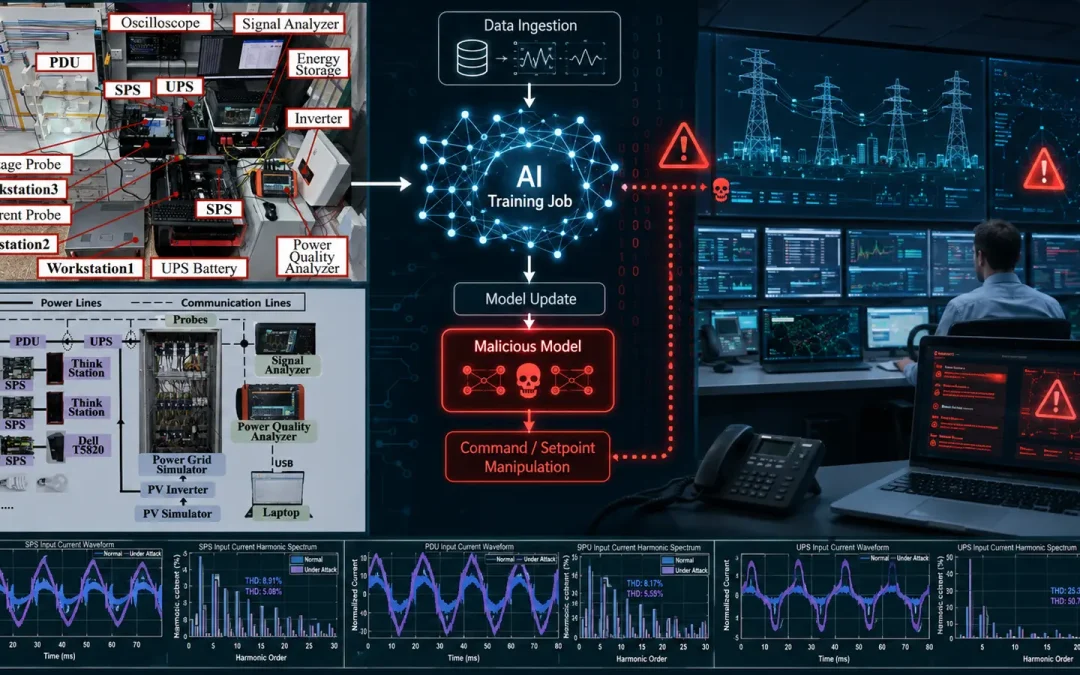
A new research threat called Bit2Watt shows how AI training jobs could be abused to disrupt the power systems that support data centers.
Rather than installing malware or breaking into grid controls, an attacker could use legitimate GPU workloads to create rapid, repeated swings in electricity demand.
The risk stems from the growing connection between large GPU clusters and renewable-heavy power networks.
When many GPUs abruptly move between heavy computation and lighter activity, the resulting power changes can travel through data-center equipment and affect local grid stability.
Researchers from Arxiv identified the issue in a paper describing Bit2Watt as a cyber-physical vulnerability.
The study warns that the behavior may evade ordinary cloud monitoring because the activity appears to be valid computing work rather than an obvious intrusion.
Arxiv said in a report shared with Cyber Security News (CSN) that the threat can operate entirely through authorized user-level controls.
That creates a different problem from conventional attacks on operational technology, such as the Sandworm power grid campaign, because no compromised utility device is required.
Hackers Could Turn AI Training Jobs Into Weapons
Bit2Watt relies on manipulating how quickly GPUs consume power. An attacker with access to a large number of rented or enterprise GPUs could coordinate workloads so systems repeatedly shift between high and low demand, producing high-frequency electrical fluctuations.
The researchers describe two approaches. One uses a specially designed GPU task for precise power switching, while the other hides the same pattern inside a normal large language model training pipeline, making suspicious activity resemble routine AI processing.
This second approach is especially concerning because tenants normally control training scripts, batch sizes, and job schedules.
A malicious user would not need administrator rights, firmware access, or direct control of electrical equipment to create the dangerous load pattern.
Modern cloud scheduling can also place related AI jobs close together to improve performance.
.webp)
That convenience could concentrate the power draw of synchronized GPUs in one location, instead of spreading the fluctuations across a wider facility and reducing their combined effect.
From Power Distortion to Outages
In simulations, the researchers found that coordinated GPU workloads could create voltage changes, electrical noise known as harmonics, and reduced system damping.
.webp)
In a worst-case model involving 1,000 GPUs and a 1-megawatt local grid with high renewable penetration, current harmonic distortion reached 46.8 percent.
The study stresses that this is a conservative, synchronized scenario rather than evidence of a real-world blackout.
.webp)
Still, it demonstrates why grid operators and data-center owners should consider computing workloads alongside traditional threats to power infrastructure.
The impact could also return to the computing environment in what the authors call Watt2Bit.
Electrical stress and heat may trigger safety protections, interrupt GPU workloads, and cause denial-of-service conditions, while electromagnetic emissions could theoretically become a covert data-leakage channel.
.webp)
Defenders should combine cloud workload monitoring with electrical telemetry that can spot unusual high-frequency demand patterns.
Providers should limit risky workload synchronization, spread large jobs across power domains where practical, and coordinate scheduling controls with power-system engineers, complementing broader guidance on securing AI systems and AI security testing.