
“`html

A novel open-source edge AI system named π RuView is transforming standard WiFi infrastructure into a through-wall human-detection platform identifying body posture, vital signs, and movement patterns without any cameras, thus raising significant security and surveillance issues.
Scholars and programmers have long speculated that ambient radio signals could be exploited for non-intrusive surveillance. That speculation has now materialized into functional code.
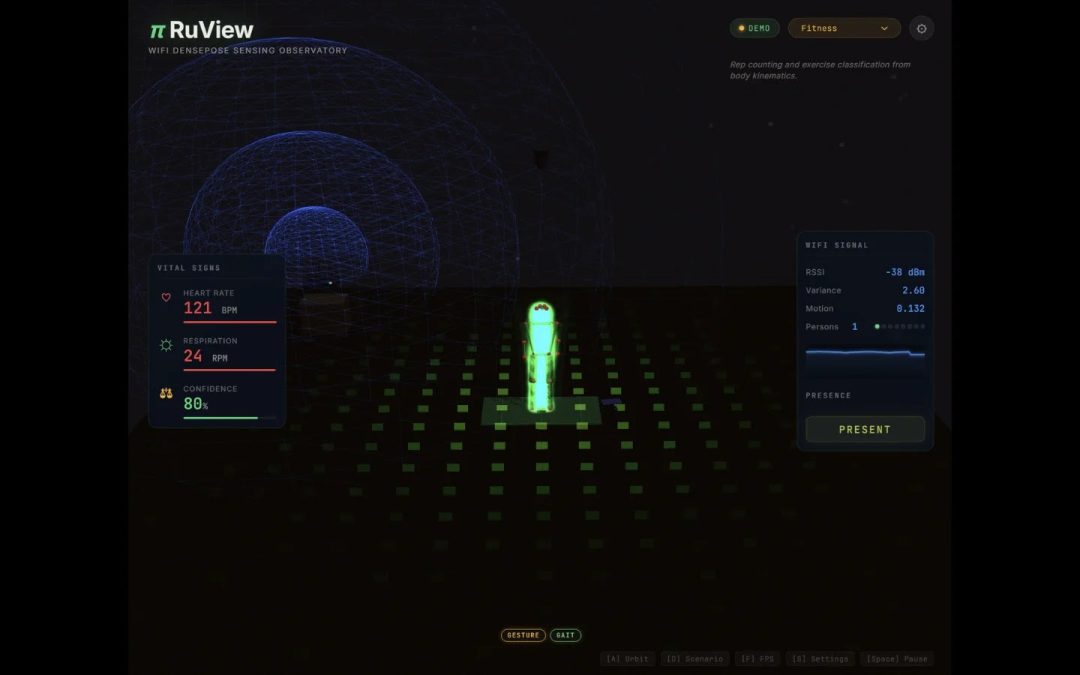
RuView, created by developer Reuven Cohen and accessible on GitHub, utilizes WiFi DensePose, an innovative sensing method initially developed by Carnegie Mellon University, as a feasible, budget-friendly edge system that reconstructs complete human poses through walls using solely conventional WiFi signals.
How the Attack Surface Operates
At its essence, the system capitalizes on Channel State Information (CSI) metadata that WiFi equipment routinely gathers to enhance signal transmission.
As a human body shifts within a wireless space, it alters signal paths across multiple OFDM subcarriers. RuView’s signal processing workflow captures these variations at 54,000 frames per second using Rust, extracts amplitude and phase changes, and channels them through a modified DensePose-RCNN deep learning framework borrowed from visual computing.
The outcome is an instantaneous reconstruction of 24 body surface areas, including arms, torso, head, and joints mapped to UV coordinates that reflect what a camera would observe, but entirely derived from RF signals.


Vital sign extraction operates simultaneously: bandpass filtering at 0.1–0.5 Hz captures breathing (6–30 BPM), whereas 0.8–2.0 Hz filtering identifies heart rate (40–120 BPM).
The most concerning security aspect is the hardware barrier or the minimal presence of one. RuView operates on ESP32 microcontroller nodes valued at around $1 each, creating a multistatic sensor network.
Four to six nodes amalgamate 12+ overlapping signal paths for comprehensive room coverage with sub-inch precision, functioning entirely offline without dependency on the cloud.
Through-wall detection reaches depths of up to 5 meters utilizing Fresnel zone geometry and multipath modeling. The system captures the RF “fingerprint” of each room over time, subsequently eliminating the static environment to isolate human movement, a consistent field model that can also recognize signal spoofing efforts. Presence detection latency remains under 1 millisecond.
In contrast to cameras, which are governed by GDPR, CCPA, and physical installation regulations, passive WiFi CSI sensing remains invisible and necessitates no physical entry to the target area.
Legal scrutiny has indicated that “it’s quite challenging to request consent from pedestrians in advance,” and consent frameworks entirely collapse when detection is passive.
GDPR already categorizes WiFi tracking identifiers as personal data, yet CSI-based body pose extraction occupies a regulatory grey area devoid of specific controls.
The attack scenario is simple: a malicious actor places a $5 ESP32 node in a building’s communal area or near a WiFi access point, deploys RuView via Docker (docker pull ruvnet/wifi-densepose:latest), and begins covertly mapping occupants’ movements, routines, and even biometric vitals through walls.
Security teams ought to regard passive RF sensing as a newly emerging physical-layer threat. Mitigation strategies encompass RF shielding in sensitive environments, oversight for unauthorized ESP32-class devices on network segments, and promoting regulatory frameworks that expand surveillance law to encompass CSI-based human tracking before the technology surpasses policy considerations.

“`