Guide
How do you answer customer security questionnaires well?
Security questionnaires are how your customers check that you will not become their weakest supplier. A repeatable process makes them faster to answer and easier to trust.
The short answer
Answer from a reviewed library of approved answers, attach evidence that supports each claim, and say no plainly when a control is missing, with the compensating control or the date it will be fixed. Learn the standard formats your buyers send, such as the SIG, CAIQ, and HECVAT. Give one person ownership, and let a SOC 2 report or trust center absorb repeat requests.
Key takeaways
- Most questionnaires are variations on a few standard formats, so learning the SIG, CAIQ, and HECVAT covers most of what buyers ask.
- A reviewed answer library, kept current and tied to evidence, is what turns a two-week scramble into a short review.
- An honest no with a compensating control or a dated plan is safer and more credible than an overstated yes.
- Every answer needs an owner and a review date, because answers drift out of date as your environment changes.
- A SOC 2 report, an ISO/IEC 27001 certificate, or a published CAIQ lets many customers accept a document instead of a fresh questionnaire.
The way to answer security questionnaires well is to stop treating each one as a new project. Build a reviewed library of approved answers, attach evidence that supports each claim, and say no plainly when a control is missing, along with the compensating control or the date it will be fixed. Give one person ownership of the process. Then let a SOC 2 report, an ISO/IEC 27001 certificate, or a trust center answer the questions customers keep asking.
Questionnaires exist because your customers are expected to manage the risk their suppliers bring. The NIST Cybersecurity Framework 2.0 describes this directly: organizations should perform "planning and due diligence ... to reduce risks before entering into formal supplier or other third-party relationships" (GV.SC-06), and should keep assessing and monitoring supplier risk "over the course of the relationship" (GV.SC-07). Your questionnaire answers are the record your customer uses to meet that expectation. Reviewers read them closely, and they may end up attached to the contract.
Which questionnaire formats do buyers send?
Most questionnaires are either a standard format or a custom set of questions built from one. Knowing the standards tells you what reviewers are trying to learn.
| Format | Published by | Who sends it | What to know |
|---|---|---|---|
| SIG (Standardized Information Gathering) | Shared Assessments | Banks, insurers, and large enterprises | Updated at least annually. Requesters scope it to Lite, Core, or Detail depth, or mix levels by domain. |
| CAIQ | Cloud Security Alliance | Buyers of SaaS, PaaS, and IaaS | Yes/no questions mapped to the Cloud Controls Matrix (CCM). CCM v4.1 and CAIQ v4.1 were released in January 2026. |
| HECVAT | EDUCAUSE | Colleges and universities | Current version is HECVAT 4. Covers cybersecurity, privacy, IT accessibility, compliance, and AI. |
| Custom spreadsheets and portals | Individual customers | Anyone | Often adapted from the standards above, with their own wording and scoring. |
A few details matter when you complete these.
- SIG. Shared Assessments describes three depths. SIG Lite is for basic due diligence, SIG Core is for vendors that handle highly sensitive or regulated information, and SIG Detail is the full question set. The 2026 SIG workbook added scoping presets for these levels, so ask the requester which depth they sent before you start.
- CAIQ. The CSA STAR Registry accepts both v4.0 and v4.1 submissions until December 2027. After that, new submissions must use v4.1, and CSA plans to withdraw the v4.0.x versions in January 2028. If you are completing a CAIQ for the first time now, use v4.1.
- HECVAT. HECVAT 4 combines the former Full, Lite, and On-Prem versions into one file. Screening questions at the start determine which sections apply to your product. EDUCAUSE expects solution providers to complete it once per year and share the same file with any institution.
What goes in an answer library?
Most questionnaires ask the same questions in different words. An answer library captures each approved answer once, so the next questionnaire becomes a matching and review exercise.
A useful library entry has:
- The question, written in plain terms, with the SIG, CAIQ, or HECVAT references it maps to.
- A short answer (yes, no, partial, or not applicable) and a two- to four-sentence explanation.
- The evidence that supports it, by document name and version.
- An owner, the date it was last reviewed, and the date it next needs review.
Write explanations for a reviewer who knows security but not your company. Name the control, the tool category, and how often it runs. "Production access requires single sign-on with phishing-resistant MFA, and access is reviewed quarterly" is a better answer than "We follow industry practices."
What evidence should you attach?
Reviewers trust answers they can check. Keep a standard evidence pack ready and share it under a non-disclosure agreement where the content is sensitive.
- Policies. Information security policy, access control, incident response, business continuity, vendor management, and acceptable use. Each should show an approval date.
- Assurance reports. Your SOC 2 report or ISO/IEC 27001 certificate, if you have one. SOC 2 reports are normally shared under NDA.
- Testing. A penetration test letter of attestation from the testing firm, stating scope and dates. A summary letter is usually enough; the full report rarely needs to leave your company.
- Insurance. A current certificate of cyber insurance, if the customer asks for one.
- Architecture. A high-level data flow diagram and a list of subprocessors.
How should you answer when a control is missing?
Overstating a control is the most expensive mistake in this process. Questionnaire answers can become contractual representations, and an inaccurate yes surfaces at the worst time, during an incident or an audit.
A "No" answer is rarely fatal on its own. What reviewers want to see is that you understand the gap and are managing it. A strong partial or negative answer has three parts:
- The current state. "We do not yet run a formal data loss prevention tool."
- The compensating control. "Customer data is restricted to production systems, and bulk exports are logged and alerted on."
- The plan. "We are evaluating DLP tooling, with a decision planned for Q1 2027."
A specific no, with a compensating control and a date, reads as a mature program. A vague yes reads as a risk.
If you cannot answer a question accurately in the time available, say so and offer a follow-up call. That is better than guessing.
Who should own the process?
Someone needs to own questionnaires end to end. In a growing company, this is often a security lead, a compliance manager, or a virtual CISO, working with sales engineering.
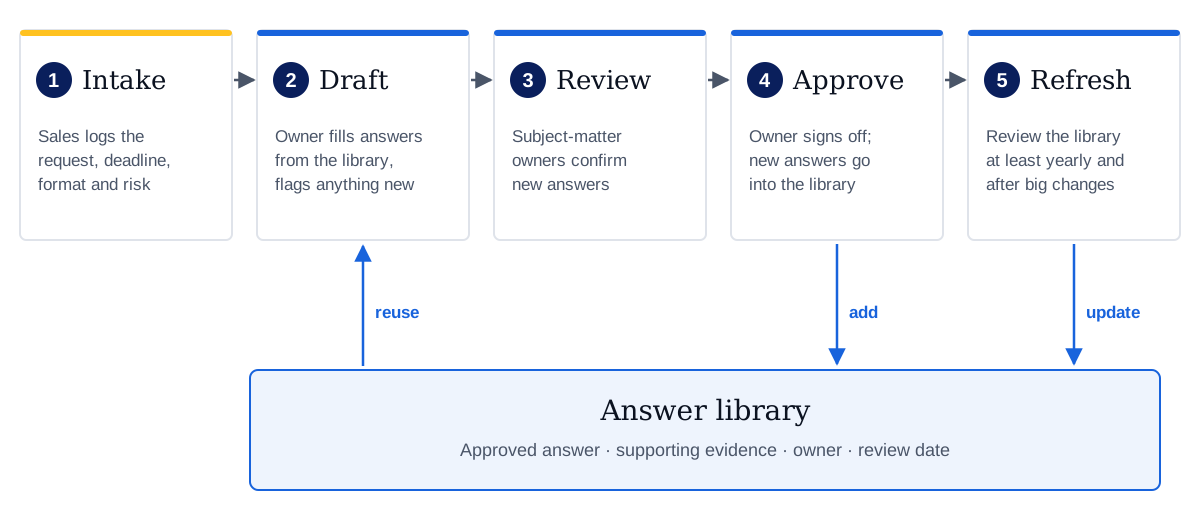
A workable process:
- Intake. Sales logs the request, the deadline, the format, and the deal size or risk level.
- Draft. The owner fills answers from the library and flags anything new or changed.
- Subject-matter review. Engineering, IT, legal, or HR confirm the new answers in their area.
- Approval. The owner signs off before the answers leave the building, and new answers go back into the library.
- Refresh. Review the whole library at least annually, and after any major change to your systems, vendors, or policies.
Set expectations on turnaround early. A first questionnaire without a library often takes one to two weeks. Once the library is in place, standard questionnaires can move much faster, and the remaining time goes to questions that are genuinely new.
How can you reduce the number of questionnaires?
You cannot stop customers sending questionnaires, but you can give them something to accept instead.
- Assurance reports. A SOC 2 report or an ISO/IEC 27001 certification answers many questions with one independently tested document. Many reviewers will accept one in place of large parts of a questionnaire.
- A published CAIQ. CSA STAR Level 1 is a CAIQ self-assessment published to the STAR Registry. Level 2 builds on a third-party SOC 2 attestation or ISO/IEC 27001 certification.
- A completed HECVAT. For higher education buyers, a current HECVAT 4 can go to every institution that asks.
- A trust center. A web page that publishes your security overview and lets customers request the SOC 2 report and evidence pack under NDA, without a sales call.
A practical checklist
- Identify the formats your buyers send most (SIG, CAIQ, HECVAT, custom).
- Build an answer library with owners and review dates.
- Assemble a standard evidence pack and an NDA template.
- Write a rule for gaps: current state, compensating control, plan with a date.
- Name a single owner and a subject-matter reviewer for each area.
- Track turnaround time per questionnaire.
- Review the library at least annually and after major changes.
- Decide whether a SOC 2 report, ISO/IEC 27001 certification, published CAIQ, or trust center would absorb repeat requests.
If questionnaires are slowing your sales cycle, our security questionnaire service can help you answer the current one and build the library for the next. You can also talk to us about where to start.
Sources
Last reviewed . Rules and guidance change, so confirm details against the sources below. General guidance, not legal advice.
- What's New in the 2025 SIG Update, Shared Assessments, 2024-10-31
- Coming Soon: 2026 SIG Workbook: Key Updates and Enhancements, Shared Assessments, 2025-07-18
- CCM v4.1 Transition Timeline, Cloud Security Alliance, 2026-02-19
- Security, Trust, Assurance and Risk (STAR), Cloud Security Alliance
- Higher Education Community Vendor Assessment Toolkit, EDUCAUSE
- HECVAT 4: Better than Ever, EDUCAUSE Review, 2025-02
- The NIST Cybersecurity Framework (CSF) 2.0 (NIST CSWP 29), National Institute of Standards and Technology, 2024-02-26
Next step
Answer this questionnaire, and build the library for the next one
We answer the questionnaire in front of you, with evidence, and leave you an answer library with owners and review dates so the next one becomes a short review.