Explainer
What is a virtual CISO, and when does a company need one?
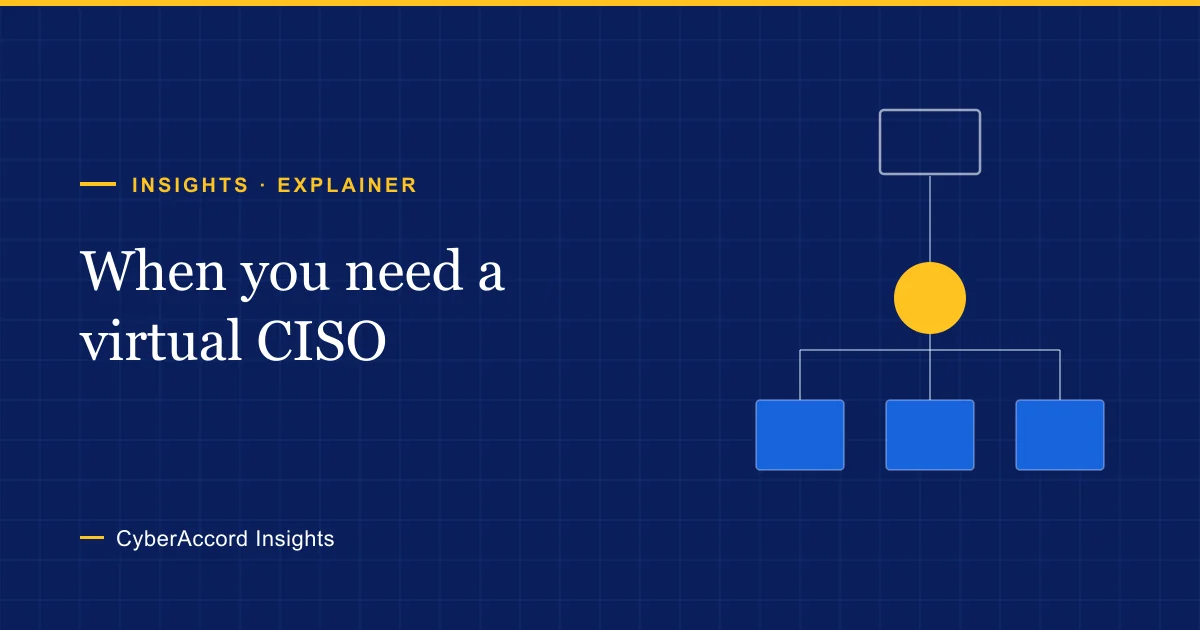
Most growing companies reach a point where security questions need an owner with authority and judgment, but not a full-time executive. That is the gap a virtual CISO fills.
The short answer
A virtual CISO is an experienced security leader who runs your security program part-time, under contract, instead of as a full-time employee. Companies usually need one when customers, auditors, insurers or regulators start asking who owns security. NYDFS Part 500 and the FTC Safeguards Rule both allow the role to be outsourced, but the company keeps responsibility and names a senior overseer.
Key takeaways
- A virtual CISO leads the security program part-time: strategy, risk, policies, incident readiness and reporting to leadership. The day-to-day operation stays with your IT team, IT provider or managed security provider.
- Common triggers are detailed customer security reviews, a first SOC 2 or ISO 27001 audit, a regulation that names a security role, insurance applications, an incident, and board questions no one can answer.
- 23 NYCRR 500.4(a) and 16 CFR 314.4(a) both allow the security lead to work for a third-party service provider, but the company keeps responsibility for compliance and must name a senior person to oversee them.
- The HIPAA Security Rule requires a named security official (45 CFR 164.308(a)(2)), and NIST CSF 2.0 treats clear cybersecurity roles and leadership accountability as part of governance (GV.RR).
- Judge a vCISO on relevant experience, independence from the tools they recommend, clear deliverables and a defined first 90 days, not on title alone.
A virtual CISO, or vCISO, is a chief information security officer you engage part-time rather than employ full-time. The role is the same: someone with the authority and experience to set security direction, make risk decisions, keep the program running and explain it to leadership, customers and auditors. What changes is the number of hours and the contract.
For many small and mid-sized companies, the question is not whether security needs a leader but when. This explainer covers what a vCISO does, the signs that it is time, how the role fits alongside your IT provider and any managed security service, which regulations allow the role to be outsourced, and how to judge a candidate.
What does a virtual CISO do?
A vCISO owns the security program. They do not usually configure firewalls or triage alerts. They decide what matters, make sure the right people do the work, and report on whether it is working.
Typical responsibilities:
- Strategy and roadmap. A prioritized plan tied to business goals, customer commitments and regulatory duties.
- Risk assessment and risk register. Identify and rate risks, record the decision on each one, and track treatment to closure.
- Policies and standards. Write the policy set and keep it current as the company and its tools change.
- Incident readiness. An incident response plan, defined roles, and tabletop exercises so the plan has been tested before it is needed.
- Oversight of testing. Scope and schedule penetration tests and vulnerability assessments, then make sure findings get fixed.
- Vendor and service provider risk. Review the providers that hold your data or run your systems.
- Audits and customer reviews. Represent the program in SOC 2 or ISO 27001 audits, security questionnaires and customer calls.
- Reporting. Regular updates to executives and, where there is one, the board.
The NIST Cybersecurity Framework 2.0 describes this kind of work under its Govern function. Its Roles, Responsibilities, and Authorities category (GV.RR) expects that organizational leadership is responsible and accountable for cybersecurity risk (GV.RR-01), that cybersecurity roles and authorities are established, communicated, understood and enforced (GV.RR-02), and that adequate resources are allocated (GV.RR-03). A vCISO is one way to put a named person behind those outcomes.
When does a company need one?
There is no size threshold. The need usually shows up as a set of questions that no one in the company is qualified, or has the time, to answer. These are the triggers we see most often:
| Trigger | What it looks like | What a vCISO adds |
|---|---|---|
| Customer security reviews | Long questionnaires, requests for policies, calls with a customer's security team | Consistent, accurate answers and someone who can speak for the program |
| A first SOC 2 or ISO 27001 audit | A customer or partner asks for a report or certificate | Scope decisions, gap assessment, policy set and audit readiness |
| A regulation that names a role | NYDFS Part 500, the FTC Safeguards Rule or the HIPAA Security Rule | A qualified person in the required role, with documented oversight |
| Cyber insurance applications | Detailed control questions at application or renewal | Accurate answers and a plan for the gaps the questions expose |
| An incident or near miss | A compromised mailbox, ransomware scare or payment fraud attempt | Root cause, lessons learned, an updated plan and leadership reporting |
| Board or investor questions | "Who owns security, and how do we know it is working?" | A clear owner, a risk register and a regular report |
| Growth or change | New products, acquisitions, a move to the cloud | Security built into the change instead of added afterwards |
One trigger alone may be manageable. Two or three at once usually means security decisions are falling to a CTO, an IT manager or no one in particular. That is the point where a part-time leader pays for the attention it brings.
Can a regulated company outsource the CISO role?
Several regulations require a named security lead, and two of them say explicitly that the person may work for a service provider.
NYDFS Part 500. Section 500.4(a) requires each covered entity to designate a CISO, who may be employed by the covered entity, one of its affiliates or a third-party service provider. If the CISO is outsourced, the covered entity must retain responsibility for compliance, designate a senior member of its personnel responsible for direction and oversight of the third-party service provider, and require the provider to maintain a cybersecurity program that protects the covered entity. Under 500.4(b), the CISO reports in writing at least annually to the senior governing body on the program, including material cybersecurity risks, overall effectiveness and plans for remediating material inadequacies. Section 500.4(c) adds timely reports on material issues such as significant cybersecurity events. Covered entities that qualify for the limited exemption in 500.19(a) are exempt from 500.4. Our NYDFS 500 page covers the wider regulation.
FTC Safeguards Rule. Section 314.4(a) requires a Qualified Individual to oversee, implement and enforce the information security program. The Qualified Individual may be employed by you, an affiliate or a service provider. If you use a service provider, you must retain responsibility for compliance, designate a senior member of your personnel to direct and oversee the Qualified Individual, and require the provider to maintain an information security program that protects you. The FTC's business guidance adds that the person does not need a particular degree or title. Our guide to the Safeguards Rule for small firms explains who is covered.
HIPAA Security Rule. Section 164.308(a)(2) requires covered entities and business associates to identify the security official responsible for developing and implementing the Security Rule's policies and procedures. The rule does not say the official must be an employee. Many practices name an internal person as security official and use a vCISO to support them with the risk analysis and policies.
Public companies. Item 106(c)(2) of Regulation S-K asks registrants to describe management's role in assessing and managing material cybersecurity risks, including which management positions are responsible and the relevant expertise of those people. If a vCISO fills that role, expect their background and reporting line to appear in the annual report disclosure.
How is a vCISO different from your IT provider or an MSSP?
The three roles are complementary, and confusion between them is a common reason security work falls through the cracks.
| IT provider | Managed security provider (MSSP) | Virtual CISO | |
|---|---|---|---|
| Main job | Keep systems running: devices, accounts, networks, help desk | Operate and monitor security controls, and respond to threats | Lead the program: priorities, risk, policy, reporting |
| Typical outputs | Working systems, tickets closed | Protection deployed and tuned, alerts triaged, incident response | Roadmap, risk register, policies, incident plan, leadership reports |
| Answers the question | "Is it working?" | "Is it protected, and is someone watching?" | "Are we managing the right risks, and can we show it?" |
| Accountable to | Operations or finance | IT and security leadership | Executives and the board |
At CyberAccord, our managed security service runs endpoint security, email security and cloud security, and works alongside your IT provider rather than replacing them. A vCISO sits above both: they decide what the protection needs to achieve, check that it does, and report the result. One provider can do more than one role, but each role needs a clear owner, and the person checking the work should be able to say so when it falls short.
How do you evaluate a vCISO?
Titles vary, so look at substance:
- Relevant experience. Has the person led programs in your sector or under your regulations? Ask for the kinds of audits, regulators and customer reviews they have handled.
- Credentials that match the work. Leadership and governance credentials, such as CISSP or CISM, signal breadth. They do not replace experience.
- Independence. A vCISO should be able to recommend tools and services from any vendor, including competitors of the firm that employs them. Ask how conflicts are handled.
- Defined deliverables. You should know what you will receive, such as a risk register, policy set, incident plan and regular reports, and how often.
- Availability. Agree on scheduled time, response expectations for urgent issues, and how hours can increase during an audit or incident.
- Communication. The vCISO will speak to your board, customers and auditors. Ask for a sample executive report.
- Location and data handling. Confirm where the vCISO is based and how they will access and store your sensitive information.
What happens in the first 90 days?
A good engagement starts with assessment and moves quickly to decisions. A typical sequence:
First month: understand. Interview leadership, IT and key staff. Inventory systems, data and providers. Collect existing policies, past test reports, insurance applications and customer commitments. Identify which regulations and contracts apply.
Second month: assess and decide. Complete a risk assessment against a framework that fits your obligations, often NIST CSF 2.0. Build the risk register and agree on owners. Close any urgent gaps, such as missing multi-factor authentication on email or administrator accounts.
Third month: plan and report. Present a prioritized roadmap with budget guidance. Draft or update the core policies and the incident response plan. Agree on the reporting rhythm, and deliver the first leadership report.
After that, the work becomes routine: risk reviews, testing, training, provider reviews, customer questions and regular reporting. The goal is a program that runs on a schedule, so audits and security questionnaires draw on existing evidence instead of starting a scramble.
Where to start
Write down the security questions your company has been asked in the last year, by customers, auditors, insurers, regulators or your own board, and who answered each one. If the answers came from different people, took weeks, or relied on guesswork, you have found the gap.
Then decide what the role needs to cover: a regulatory designation, audit readiness, customer reviews, incident readiness, or all of these. That sets the scope of the engagement. Our vCISO service provides a U.S.-based security leader who works with your IT team or provider, and our wider advisory services cover the testing and compliance work the roadmap calls for. If you want to talk through whether you need one yet, contact us.
Sources
Last reviewed . Rules and guidance change, so confirm details against the sources below. General guidance, not legal advice.
- 23 NYCRR Part 500, Cybersecurity Requirements for Financial Services Companies (Second Amendment), New York State Department of Financial Services, 2023-11-01
- 16 CFR 314.4, Elements (Standards for Safeguarding Customer Information), Electronic Code of Federal Regulations (eCFR), 2026
- FTC Safeguards Rule: What Your Business Needs to Know, Federal Trade Commission
- 45 CFR 164.308, Administrative safeguards, Electronic Code of Federal Regulations (eCFR), 2026
- The NIST Cybersecurity Framework (CSF) 2.0 (NIST CSWP 29), National Institute of Standards and Technology, 2024-02-26
- 17 CFR 229.106, Item 106 Cybersecurity (Regulation S-K), Electronic Code of Federal Regulations (eCFR), 2026
Next step
Give security a qualified owner
Our U.S.-based vCISOs lead your program part-time: risk assessment, policies, incident response planning, customer and audit support, and regular reporting to leadership.